
Population statistics of India’s beggars:25% of beggars in India are Muslim

New Delhi July 29: The following data is from the Census 2011, gives the statistics of India’s beggar population.While the population of Muslims stands at 14.23% of India’s total, their percentage in the number of beggars is comparatively high.A total of 92,760 Muslims are categorised as a quarter of the country’s total beggar population of 3.7 lakh.
As per the Census 2011, ‘non workers’ are people who are non-participant in any economic activity (paid or unpaid), household duties or cultivation.
The Census 2011 categorised 72.89 crore individuals as non workers and of these, 3.7 lakh are beggars.
In the 2001 Census, 6.3 lakh individuals were categorised as beggars. The difference between the 2011 and 2001 numbers is a good 41 percentage points.
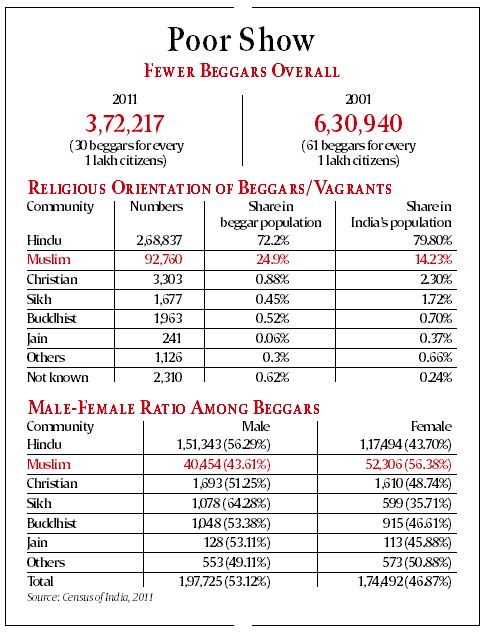
According to The Indian Express, Hindus, who make up 79.8% of the total population, had 2.68 lakh individuals as beggars (72.22% of India’s total beggar population).
Christians – 2.3% of the total population – make up 0.88% of the beggar population (3,303 individuals). Buddhists (0.52%), Sikhs (0.45%), Jains (0.06%) and others (0.30%) follow.
The report further suggests that more Muslim women opt begging compared to men. The ratio in the Muslim community stands at is 43.61% male beggars and 56.38% female.
Beggary is an age old social phenomena in India and is criminalized in cities such as Mumbai and Delhi as per the Bombay Prevention of Begging Act, BPBA (1959).
Under this law, officials of the Social Welfare Department assisted by the police, conduct raids to pick up beggars who they then try in special courts called ‘beggar courts’.
If convicted, they are sent to certified institutions called ‘beggar homes’ also known as ‘Sewa Kutir’ for a period ranging from one to ten years for detention, training and employment.
The Act gives discretionary powers to the police to pick up anyone on suspicion that he is a beggar or a destitute with no means of fending for himself.
Activists say the law, rather than rehabilitating destitutes, criminalises the poor and those suffering from mental illnesses. Some states like Bihar have undertaken a programme for the rehabilitation of beggars. But other states like Maharashtra and West Bengal can put away an individual found on the street to prison.
Like many of India’s laws, the anti-beggary legislation is based on an archaic British law against vagrants.


