
Gujarat Model Development resumes as the government excludes private vehicles from toll tax payment
For at least the past couple of years in India, much has been made of the “Gujarat model of development”, and the media have widely projected the idea that the State of Gujarat and its citizens have flourished because of effective and decisive governance, particularly in the realm of economic policies. This public perception probably played an important role in the Bharatiya Janata Party’s (BJP) general election victory.
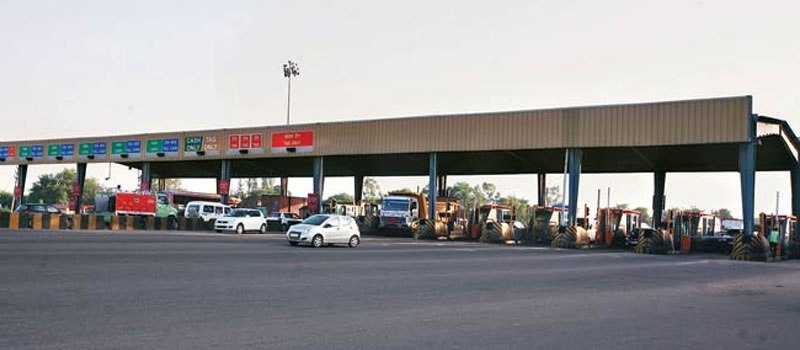
With the 2017 assembly election in sight, CM Anandiben Patel on Saturday announced that cars and small vehicles, including three-wheelers, will be exempted from paying toll tax on state as well as national highways in Gujarat from August 15.
However, this exemption is limited to private vehicles. Taxis and other commercial vehicles will have to pay regular toll tax. Patel made the announcement while inaugurating the Amra Van Mohatsav at Balchondi village in the tribal dominated Kaprada taluka of Valsad. Addressing a meeting amid heavy rainfall, she said the state government will be issuing a notification in this regard on August 15. The revenue loss at toll booths will be borne by the state in order to facilitate the commuters.
There are around 50 toll booths in the state. Government officials said the initial estimate of loss in revenue was between Rs 80 crore and Rs 100 crore. But the decision to include national highways in the scheme will increase losses to Rs 250 crore per annum.
There are nearly 31 state highways with a total length of 19,761 km, while 12 national highways passing through the state cover 4,032 km. The officials, however, were not able to clarify as to how they plan to make up for the loss
Transport minister Vijay Rupani said, “The tax exemption will be applicable to all toll booths in the state, including those on national highways.”
When asked about jurisdiction of the state government on toll tax collected on national highways, he said, “The government is aware that the toll booths on national highways are not in its jurisdiction, but state government will compensate the contractor of toll booths on national highways.”
Other side of ‘Gujarat Model Development’
Modi’s detractors such as Congress vice-president Rahul Gandhi and Arvind Kejriwal, chief of the Aam Aadmi Party (AAP), say the Gujarat model is over-hyped and is a synonym for crony capitalism; they say it has only benefited a few big industrialists who received land at throwaway prices.
A scholarly, well-researched book shows that the much-vaunted “growth” in Gujarat in the last decade has benefited big capital more than the common man.
Unfortunately, much of the recent literature on the State, even by reputed economic analysts, has been uncritical and verging on the hagiographic, and so has not provided a sober assessment of actual trends. Thus, GDP growth tends to be lauded without looking at its composition or its impact on mass consumption. Poverty reduction in Gujarat is highlighted as a big success when the evidence suggests that it has been slower than most other States despite higher growth and generally confined to rural areas, with almost stagnant levels of urban poverty.
The genuine progress in electrification and some other infrastructure is certainly to be welcomed, but, typically, it is lauded without noting that this has worked largely for the benefit of the corporate sector, with little improvement in infrastructure for the masses. Gujarat, like many other States, has a proliferation of supposedly innovative “schemes” and “programmes” but most positive accounts simply list these in glowing terms without assessing how they can work with very limited funds and very small numbers of staff.
In this less-than-balanced context, a new book that seeks to consider economic processes in Gujarat objectively is greatly to be welcomed. Growth or Development: Which way is Gujarat going? (Oxford University Press, 2014), edited by Indira Hirway, Amita Shah and Ghanshyam Shah, provides a sober, balanced and solidly researched account of Gujarat’s development over the past decade. The various articles in the book cover most of the important aspects of economic growth and social development and enable us to develop a more concrete understanding of both economic processes and the State government policies that have been associated with them.
What is Gujarat Model Development?
In the space of a decade, Tunda Vandha, in Kutch district of Gujarat, has been transformed from a sleepy village of mud houses populated by cattle breeders into a prosperous industrial town.
In its vicinity are two of India’s largest coal-fired power projects—Tata Power Co. Ltd’s subsidiary Coastal Gujarat Power Ltd (CGPL) has set up a 4,000 megawatts (MW) plant and has plans to add 1,600MW more; Adani Power Ltd has built a 4,650MW power station.
The two plants brought Rs.40,000 crore into the local economy and changed the lives of local residents—the Rabari community, which has been widely represented as the face of Gujarat in tourism billboards, the menfolk clad in all white, sporting a turban; and the women in black ghagra-cholis, wearing gold or silver jewellery.
Dotted with kutchi bhungas—circular mud houses with thatched roofs—the place was a quaint tourist destination until early 2000 and attracted film-makers like J.P. Dutta, who shot a part of his movie, Refugee, in the village, said Mandabhai Rabari, deputy sarpanch (headman).
Mandabhai and his family sold about 5 acres of land to Adani Power for about Rs.30 lakh. His wife, Lakhiben Rabari, who once made Kutchi handicrafts, now works as a contract worker at the Adani Power plant.
“Earlier I earned Rs.1,500 per month by selling hand-woven garments. My eyes used to ache. Today I earn Rs.5,000 per month. Everybody in the village earns directly or indirectly from these two factories,” Lakhiben said.
The Ahmedabad-based Adani Group, with $8.7 billion in revenue in 2013, runs India’s largest merchant port in Mundra in Kutch, which has the capacity to handle more than 100 million tonnes (mt) of cargo.
The Adanis have also built India’s largest multi-product special economic zone (SEZ) in Mundra. The Modi government announced an SEZ policy in 2004 for the state—before the central government’s 2005 policy—to encourage the development of the export-oriented industrial enclaves. The policy offers easy labour laws and tax exemptions.
The Adani Group has acquired a lot of wasteland from various governments, including the Congress-backed one in 1993, but it was between 2005 and 2007 that it secured the largest portion of about 5,000 hectares out of a total 7,300 hectares, said an official at the group who spoke on condition of anonymity.
In reply to a question, state revenue minister Anandiben Patel informed the House in March 2012 that 54,656,819 sq. m (about 5,400 hectares) of land was given for Adani’s SEZ project at prices ranging from Rs.1 to Rs.32 per sq. m till December 2011.


