
Gender stereotype bias and sex stereotyping in children textbooks:Inequality in education

August 4:If you consider the scores of kindergarten to teenage books like the Very Hungry Caterpillar ,to the Cat in the Hat, Peter Rabbit to Babar the elephant, children’s books are dominated by male central characters, new research has found, with the gender disparity sending children a message that “women and girls occupy a less important role in society than men or boys”.This was pointed out in an article in the Guardian.

The NCERT taking cognizance of the subject ,in a first ,started a gender audit of 18 of the textbooks used in primary school show shows “men mainly in a variety of professions and women as homemakers, teachers, nurses and doctors”.Th is article was from the Indian Express.
In another report in the World Education Blog ,Aaron Benavot, Director of the GEM Report and Catherine Jere, University of East Anglia investigate the persistence of gender bias in textbooks, and reminding policy makers that until it is addressed girls’ motivation, participation and achievement in school will continue to be undermined, affecting their future life chances.
Another reasearch article titled ” Construction of gender: a comparison of Australian and Hong Kong English language textbooks authored by Jackie F.K. Leea and Peter Collinsb asks whether gender imbalances matter ?
Do the gender imbalances described above matter?
According to a number of writers, the answer to this question is ‘yes’.
Smith (1985) states that there are several ways in which educational materials serve to instil values and attitudes in young people.
First, since students usually attach a great deal of credibility and authority to educational and reference materials, they are less likely to be critical of these than they are of the media.
Second, since learners are frequently required to absorb and assimilate the textbook material in minute detail, they will be attentive to the messages conveyed, and susceptible to their influence.
Many writers are of the view that the content of textbooks has the potential to influence the learners’ worldview.
In yet another study of the issue in a study paper titled” Eliminating gender bias in textbooks: Pushing for policy reforms that promote gender equity in education by Rae Lesser Blumberg,found the research that as well as the current study have found a remarkably similar pattern of gender bias in textbooks virtually worldwide:
1. Females – girls, women and animals – were strongly underrepresented.
2. Women and girls included in text or illustrations were nearly always depicted in highly stereotyped roles in the home.
3. In the relatively few cases portraying women in non-domestic occupations or activities, these were overwhelmingly of the most traditional sort.
4. Girls and women were usually passive and often watched while courageous and confident boys and men undertook exciting and worthwhile endeavors and occupations.
5. More gender-unequal countries tended to have somewhat more intense (or negative) under representation and stereotyping but similarities far exceeded variations in intensity.
6. Furthermore, research that has measured improvement over time – often decades – has found that the pace of improvement in gender bias in textbooks is more often slow (even glacial) than rapid.
Gender bias in textbooks thus remains an almost invisible obstacle to females’ equality in education and beyond. Indeed, it is a classic example of the “hidden curriculum” (Stromquist et al. 1998) that may (further) constrain girls from realizing their full potential. And when girls can’t reach their full potential, neither can their families, communities and nations (Bertini 2011; Sadker, Sadker and Zittleman 2009).
In another article by a counselling psychologist in a prominent girls college in Benguluru, Talkitover , talks about difference between sex and gender and different stereotype roles prevalent in the society.


Another article in the Guardian talks about the issue on International woman’s day,suggesting that a Unesco study of teaching materials in countries around the globe has found overwhelmingly strong gender bias in favour of males than women.
In a Turkish textbook, a girl is pictured dreaming of her wedding day, while a boy imagines becoming a doctor. In a Tunisian one, students are asked to complete sentences about Mr Thompson, who is in the garage washing his car, and Mrs Thompson, in the kitchen preparing lunch (“she [likes] cooking very much,” they discover). A new report from Unesco says that gender bias is rife in textbooks around the world, and is undermining girls’ motivation and achievement in schools.

In Chinese social studies texts, it said that “all scientists and soldiers were depicted as male while all teachers and three quarters of service personnel were female”, while in a 12-volume set of elementary Chinese textbooks women only accounted for around 20% of the historical characters, “and appeared dull and lifeless in comparison with the more vibrant males”.
In India, meanwhile, only 6% of the illustrations in primary English, Hindi, mathematics, science and social studies textbooks showed only females, while more than half showed only males, according to the report. Not a single woman was shown as an executive, engineer, shopkeeper or merchant in six mathematics books used in Indian primary schools, said the analysis from the Global Education Monitoring Report at Unesco, with men “dominat[ing] activities representing commercial, occupational and marketing situations”.
Inyet another Global Education Monitoring report details the following
It cited a 2015 Pakistan study, which “found no change in the negative portrayal of women in Pakistani textbooks since 2004”, as well as the finding in Iran in 2012 that men made up 80% of characters in books designed by the ministry of education, and a 2009 Australian study, which discovered that 57% of characters in Australian textbooks were men, with “double the amount of men portrayed in law and order roles, and four times as many depicting characters engaged in politics and government”.

This picture was found in a n article in ScoopWhoop detailing the representations of beauty and the color of the skin.
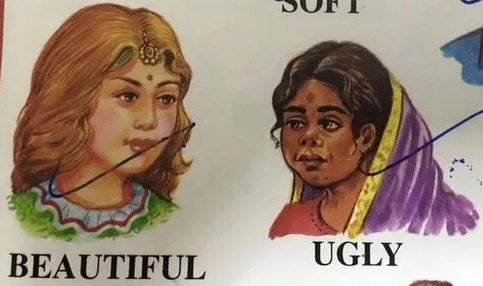
The author goes on with the presence of beauty and fairness creams advertisements that show the paleness in fair skin as beauty which is extensively prevalent in TV as well as internet ads .
Children are primarily affected by the media exposure on TV,internet,movies and advertisements
A great deal of misrepresentation is pumped into the minds of teenage youth for the purpose of meeting sales targets of products like cosmetics, swimsuit bikinis and gender roles in society.

A new study suggests that Disney Princesses and the messages they promote may influence gender-stereotypical behavior for young girls.
More about this issue is available here Disney , article on Disney cartoon characters and HuffPost article

For both boys and girls, greater interactions with princesses predicted more gender-normative behavior — like wanting to play with traditional female stereotypical toys and activities (e.g., dolls, tea sets, playing house), and behaviors (e.g., avoiding getting dirty, avoiding taking risks) — but the results were quite disparate.


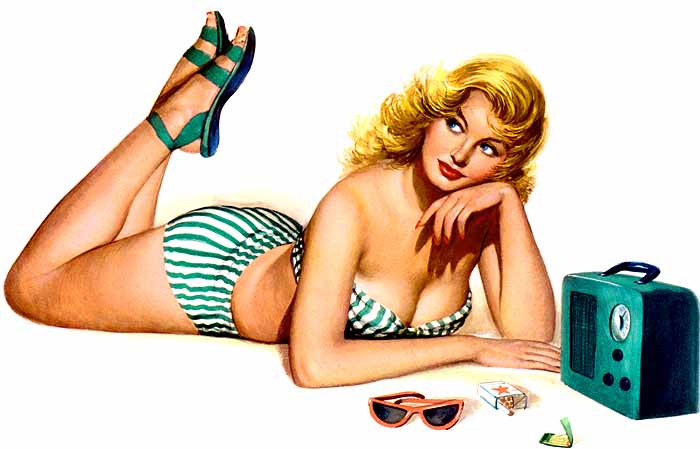
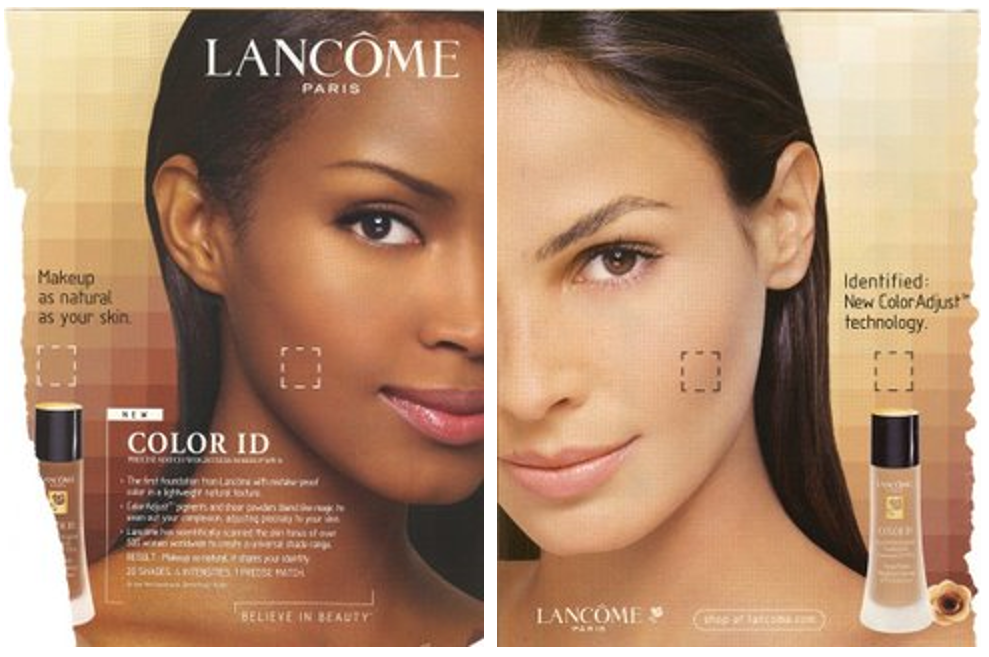

Women underwear ads promote a certain bodytype


